Insights
4 Instructional Design Principles Driving High-Performing eLearning
July 1, 2026
The best eLearning experiences don't just deliver content; they change behaviour, build skills, and improve performance.
Development
Fabella
This is some text inside of a div block.

Summary

High-performing eLearning is about more than completion rates. The best learning experiences help learners retain knowledge, apply new skills on the job, and improve performance over time.

In this article, we explore four evidence-based instructional design principles that consistently drive better learning outcomes:

  1. Start with performance outcomes, not content
  2. Manage cognitive load to improve comprehension
  3. Create opportunities for retrieval and application
  4. Design beyond the course with reinforcement and spaced learning

Together, these principles help instructional designers create eLearning that doesn't just inform learners - it changes how they perform.

What Makes eLearning "High-Performing"?

Every LMS can tell you who completed a course.

Far fewer can tell you whether that course actually changed anything.

That's the difference between completed learning and high-performing learning. If your company rolls out mandatory cybersecurity training and within two weeks, everyone has finished the course. The LMS dashboard is glowing green. Completion rate: 98%.

Three months later, employees are still clicking phishing links.

The course was completed. The learning didn't stick.

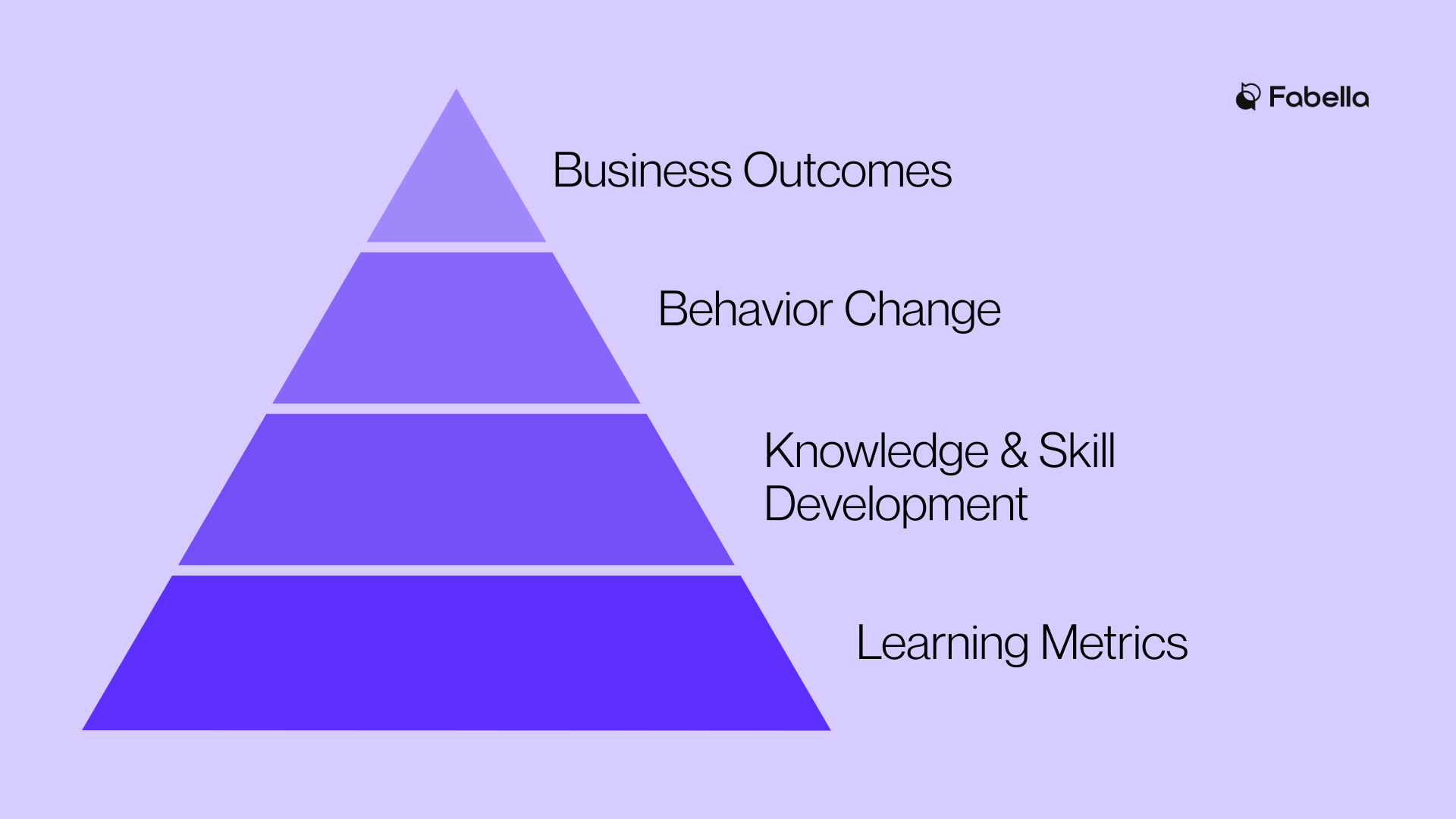
Learning only creates value when it changes behavior. That's why modern frameworks like the New World Kirkpatrick Model place so much emphasis on behavior change and business outcomes, not just learner satisfaction or knowledge checks.

So what does make eLearning high-performing?

It's learning that helps people:

  • Remember what they've learned weeks or months later.
  • Apply new skills in real-world situations.
  • Make better decisions on the job.
  • Deliver measurable business results.

We really don't have to play a guessing game here. 

Instructional designers have decades of learning science to draw from, and the research is surprisingly consistent. While authoring tools, AI, and learning platforms continue to evolve, the fundamentals of how people learn haven't changed much at all.

Again and again, the evidence points to the same four design principles. High-performing eLearning isn't longer, prettier, or more interactive for the sake of it. It's intentionally designed to improve performance.

Principle 1: Start With Performance Outcomes, Not Content

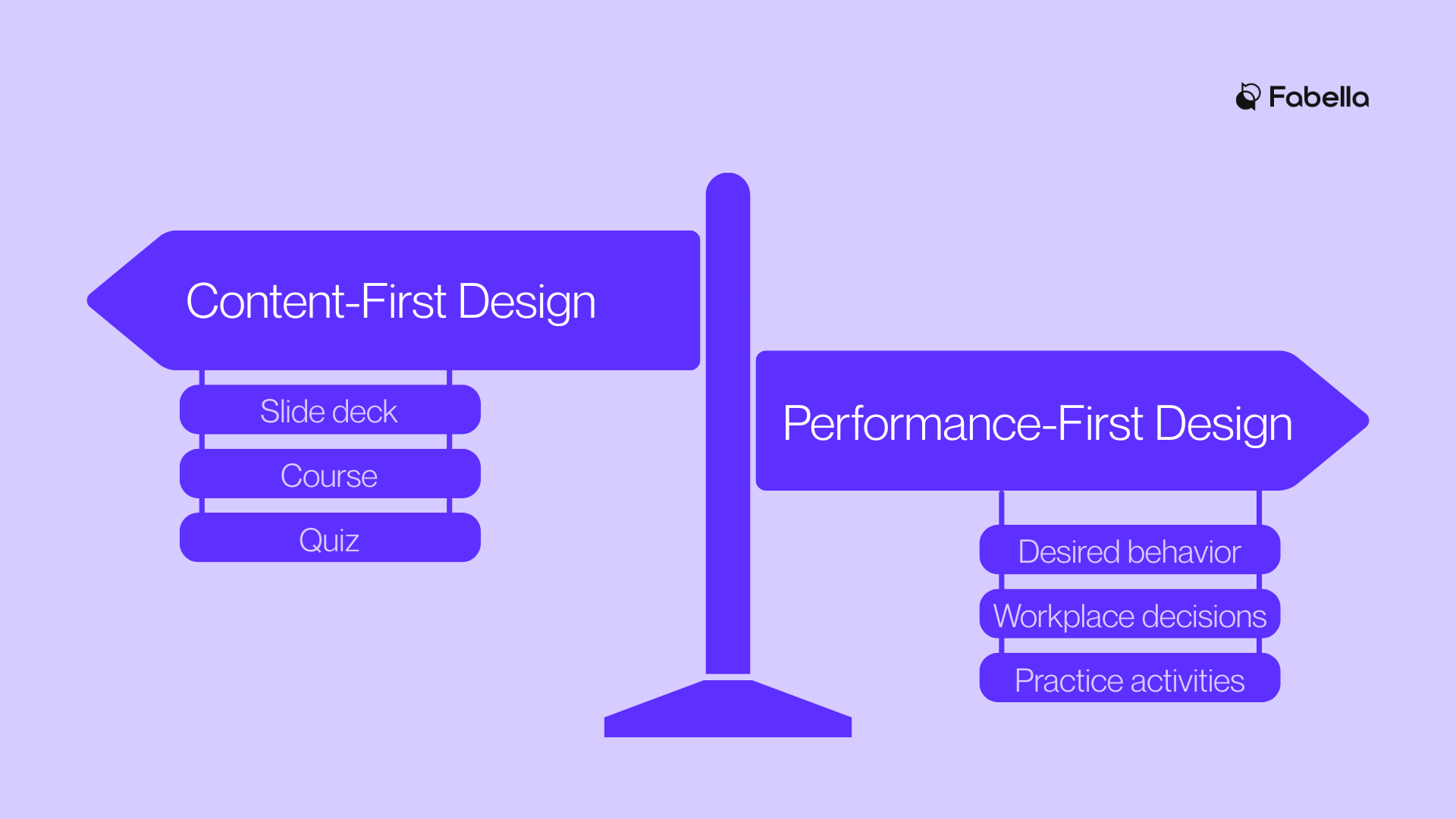
Illustration of a street sign pointing in two directions, comparing content-first design (slide deck, course, quiz) with performance-first design (desired behavior, workplace decisions, practice activities).

Imagine two onboarding courses for new sales reps.

The first walks learners through 180 PowerPoint slides covering products, pricing, company history, and competitive differentiators. By the end, learners can probably pass a multiple-choice quiz on product features.

The second looks very different.

From day one, learners are placed in realistic customer conversations. They need to identify customer needs, recommend solutions, respond to objections, and make decisions based on incomplete information. They're not just learning about the product - they're practising what they'll actually do on the job.

Which course better prepares someone for their first sales call?

Most instructional designers would choose the second.

Yet many eLearning experiences still look a lot like the first.

The Content Coverage Trap

One of the biggest challenges in workplace learning is that we're often handed content, not performance problems.

A subject matter expert shares a slide deck. A compliance team provides a policy document. A business leader asks for training on a new process.

The natural instinct is to ask:

How do we turn this into a course?

But that's often the wrong starting point.

When we begin with content, we tend to optimize for coverage. We worry about whether every policy, process step, or product feature has been included. Success becomes measured by whether learners have been exposed to the information.

The problem is that exposure doesn't guarantee performance.

Most jobs don't require people to recall information in isolation. They require people to make decisions, solve problems, navigate ambiguity, and take action.

That's why high-performing eLearning starts somewhere else entirely.

It starts with the desired performance.

Start With the End in Mind

This idea isn't new.

In their influential work on Backward Design, Grant Wiggins and Jay McTighe argued that learning experiences should begin with the outcomes learners are expected to achieve, not the content educators want to cover.

For workplace learning, that means identifying the behaviours that matter.

Not:

  • Understand the cybersecurity policy
  • Know the product portfolio
  • Learn the customer service process

But:

  • Recognise and report phishing attempts
  • Recommend the right solution to a customer
  • Resolve customer issues according to company standards

The difference may seem subtle, but it fundamentally changes how a learning experience is designed.

Once you define the behaviour, you can work backwards.

What decisions will learners need to make?

What situations will they encounter?

What mistakes are most likely?

What practice opportunities should they have before they're expected to perform on their own?

What the Research Says

Research continues to support this approach.

A 2024 review of constructive scaffolding - the principle that learning objectives, activities, and assessments should be aligned and build on each other - found strong evidence that alignment improves learning outcomes. When learners practise the same kinds of thinking and actions they'll be assessed on, learning becomes more meaningful and more transferable.

While the paper focuses on educational settings, the implications for workplace learning are clear: when objectives, practice, and assessment all point toward the same performance outcome, learners are more likely to apply what they've learned.

This aligns with decades of research on transfer. People learn more effectively when training mirrors the situations in which knowledge will eventually be used.

What This Looks Like in Practice

Let's go back to our sales onboarding example.

A content-first approach might include:

  • Product specifications
  • Pricing tables
  • Competitive comparisons
  • Company history
  • Feature lists

A performance-first approach asks a different question:

What does a successful sales rep actually do?

The answer probably looks something like this:

  • Diagnoses customer needs
  • Asks effective questions
  • Connects product capabilities to business problems
  • Handles objections confidently
  • Recommends appropriate solutions

Those become the foundation of the learning experience.

Product knowledge still matters. But it's taught in service of performance rather than as an end in itself.

The goal isn't to create a learner who can recite information.

It's to create a learner who can use it.

A Better Design Question

Before you write a learning objective, storyboard a scenario, or open your authoring tool, pause and ask:

What decision should learners make differently tomorrow?

It's a deceptively simple question.

But it shifts the focus from content to performance - and that's where high-performing eLearning begins.

Principle 2: Manage Cognitive Load So Learners Can Think

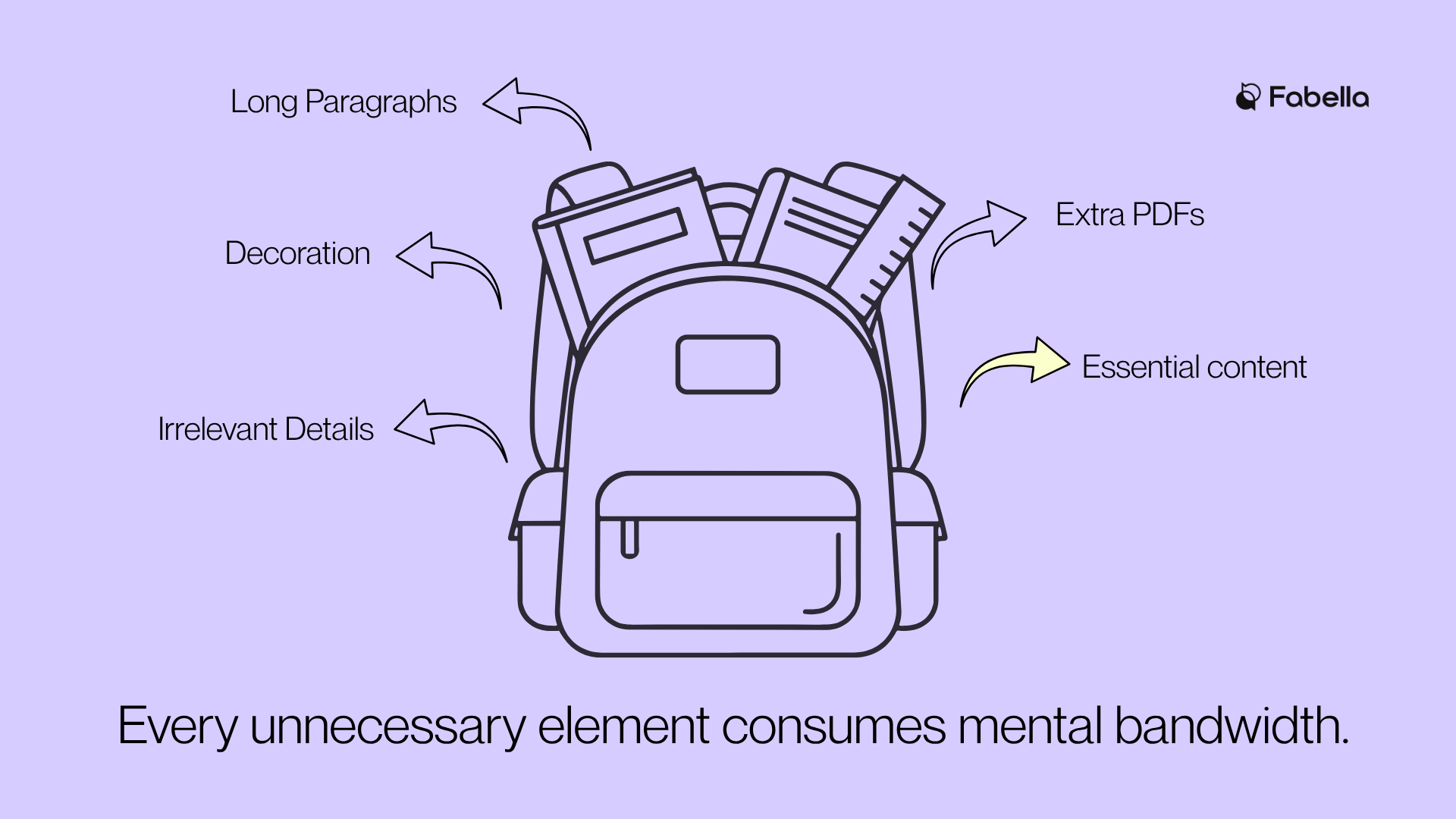
Illustration of a backpack showing essential content highlighted in yellow, while long paragraphs, decoration, extra PDFs, and irrelevant details are marked as unnecessary.

A compliance course contains:

  • 68 slides
  • Paragraphs of policy text
  • Decorative animations
  • Six downloadable PDFs

Everything is technically accurate.

Almost none of it is memorable.

We've all seen courses like this. In fact, many of us have built them. Probably not because you wanted to, but because of external factors.

The logic seems sound: if something is important, include it. If learners need to know it, add another slide. If stakeholders are worried about missing information, attach a PDF.

The result is often a course that feels comprehensive but leaves learners overwhelmed.

More Information Doesn't Equal More Learning

One of the most important ideas in instructional design is also one of the easiest to forget:

Learners have limited working memory.

At any given moment, people can only process a finite amount of information. When too much information competes for attention, learning suffers.

This is the foundation of Cognitive Load Theory, first developed by John Sweller and still one of the most influential frameworks in learning science today.

But cognitive load isn't just about the amount of content.

It's also about everything that gets in the learner's way.

Complex navigation. Unnecessary animations. Dense text. Irrelevant graphics. Information that's interesting but not essential.

Every one of these elements consumes mental resources that could otherwise be spent learning.

What the Research Says

The evidence here is remarkably consistent.

A recent review published in Frontiers in Psychology found that instructional designs that reduce unnecessary complexity help learners process information more effectively and improve learning outcomes. The authors highlight that poorly designed multimedia can increase cognitive load and interfere with learning - even when the content itself is accurate.

This builds on decades of research from Richard Mayer's Cognitive Theory of Multimedia Learning, which shows that learners perform better when instructional materials minimise what he calls extraneous processing - the mental effort spent dealing with the presentation of information rather than the information itself.

In practical terms, that means learners shouldn't have to work hard to figure out where to click, what matters, or how different pieces of information fit together.

Their mental energy should be focused on learning.

What This Looks Like in Practice

Imagine a healthcare compliance course that covers patient privacy regulations.

The original version is sixty minutes long.

It includes lengthy policy explanations, extensive legal language, multiple navigation layers, and dozens of screens learners click through as quickly as possible.

A redesign takes a different approach.

Instead of organising content around policy documents, it organises learning around the situations employees actually encounter.

The course is broken into short modules.

Each module focuses on a specific task.

Scenarios replace long blocks of text.

Visual design is simplified.

Reference material is available when needed rather than displayed all at once.

The total amount of information may not change dramatically. The learning experience does. Learners spend less time processing the course and more time processing the content.

Simplicity Is Not Dumbing Things Down

This is an important distinction.

Good instructional designers don't simplify because learners can't handle complexity. They simplify because working memory is limited. The goal is to remove distractions. Complex thinking is valuable. Complex interfaces are not.

This notion seems to have taken a backseat in the age of AI - where an incredible amount of content can be generated in seconds, with all of the bells and whistles. But fast does not equal better, and without the instructional design to back it up, the content can become pointless. 

Every element in a learning experience should earn its place. If it doesn't help learners understand, remember, or apply the content, it's probably adding cognitive load without adding learning value.

And when that happens, even the most important content becomes harder to learn.

Principle 3: Create Opportunities for Retrieval and Application

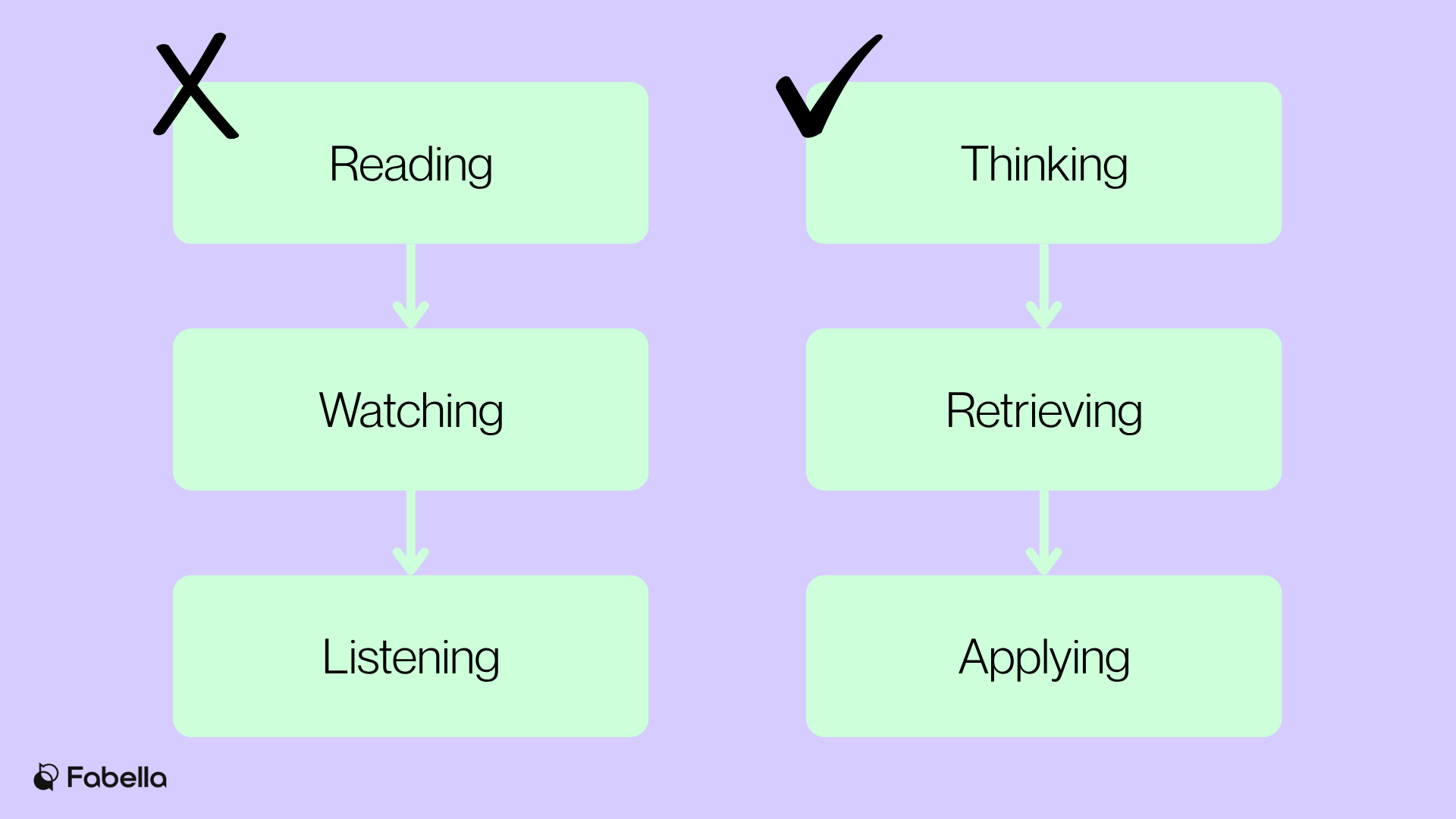
Flow diagram showing passive learning activities (reading, watching, listening) marked with an X, contrasted with active learning processes (thinking, retrieving, applying) marked with a check.

Consider two leadership courses.

In Course A, learners:

  • Watch six videos
  • Read a handbook
  • Pass a quiz

In Course B, learners:

  • Respond to difficult employee conversations
  • Receive feedback on their decisions
  • Return one week later to solve a similar scenario
  • Compare their responses and reflect on what changed

Only one of these courses repeatedly forces learners to retrieve and apply knowledge.

And according to decades of learning research, that's the one more likely to produce lasting learning.

Learning Isn’t Downloading Information

Many eLearning experiences still treat learning as a content delivery problem.

If learners watch the video, read the article, or complete the module, learning has occurred.

At least, that's the assumption.

But memory doesn't work that way.

People don't remember information because they encountered it.

They remember information because they had to use it.

One of the most robust findings in cognitive psychology is that the act of retrieving information strengthens memory more effectively than simply reviewing it. The process of pulling knowledge from memory makes future retrieval easier and more reliable.

In other words:

Reading feels productive.

Retrieval is productive.

What the Research Says

Retrieval practice is one of the most extensively studied learning strategies in the world.

A 2023 systematic review in Educational Psychology Review examined retrieval practice across health professions education and found consistent evidence that retrieval activities improve long-term retention. The effect was observed across multiple contexts and learner groups, reinforcing decades of prior research.

More recent research has also examined retrieval practice in authentic learning environments rather than tightly controlled laboratory studies. The findings continue to support the same conclusion: regularly retrieving knowledge improves retention and transfer more effectively than passive review alone.

What's particularly striking is how often learners choose strategies that feel effective - such as re-reading notes - even when retrieval-based strategies produce significantly better results.

Why Scenarios Work

This is one reason scenario-based learning is so powerful.

A good scenario forces learners to retrieve knowledge, evaluate options, make decisions, and apply what they've learned in context.

They're not simply recalling information.

They're using it.

Consider healthcare simulation training.

Medical professionals don't learn to handle emergencies by reading about them repeatedly. They learn by practising diagnosis, decision-making, communication, and intervention in realistic scenarios.

The same principle applies in corporate learning.

A customer service representative improves by responding to difficult customer situations.

A manager improves by navigating challenging employee conversations.

A salesperson improves by practising customer interactions.

The closer practice resembles performance, the more likely learning is to transfer.

Learning Happens in the Thinking

One of the reasons instructional designers love scenarios is that they reveal a learner's thinking.

A multiple-choice question can tell you whether someone selected the right answer.

A realistic scenario shows how they arrived there.

What assumptions did they make?

What information did they notice?

What trade-offs did they consider?

Those are the kinds of mental processes that drive performance in the real world.

And they're exactly the kinds of processes learners need opportunities to practise.

A Better Measure of Engagement

When people talk about engagement, they often mean interaction.

Clicks.

Hotspots.

Animations.

But engagement isn't about activity.

It's about thinking.

A learner who spends three minutes wrestling with a realistic workplace decision is often learning more than a learner who clicks through twenty screens of content.

Which leads to a simple principle that tends to get lost in the corporate urgency:

Learning doesn't happen when information is presented.

It happens when learners have to think.

Principle 4: Design Beyond the Course

A sales onboarding program ends on Friday.

By Monday, everyone has a certificate.Yay!

Three months later?

Most of the product knowledge has faded. Sales reps are still making the same mistakes. Managers are answering the same questions. Performance hasn't changed much at all. Not yay. 

Now imagine a different onboarding experience.

The course itself is only the beginning.

Learners receive weekly challenges. They revisit key concepts through short refreshers. Job aids are available exactly when they're needed.

The content is largely the same.

The results aren't.

Learning Doesn't End When the Course Ends

One of the biggest misconceptions in workplace learning is that training is an event.

We launch a course. Learners complete it. We move on to the next initiative.

The problem is that memory doesn't work that way.

Learning is a process, not a moment.

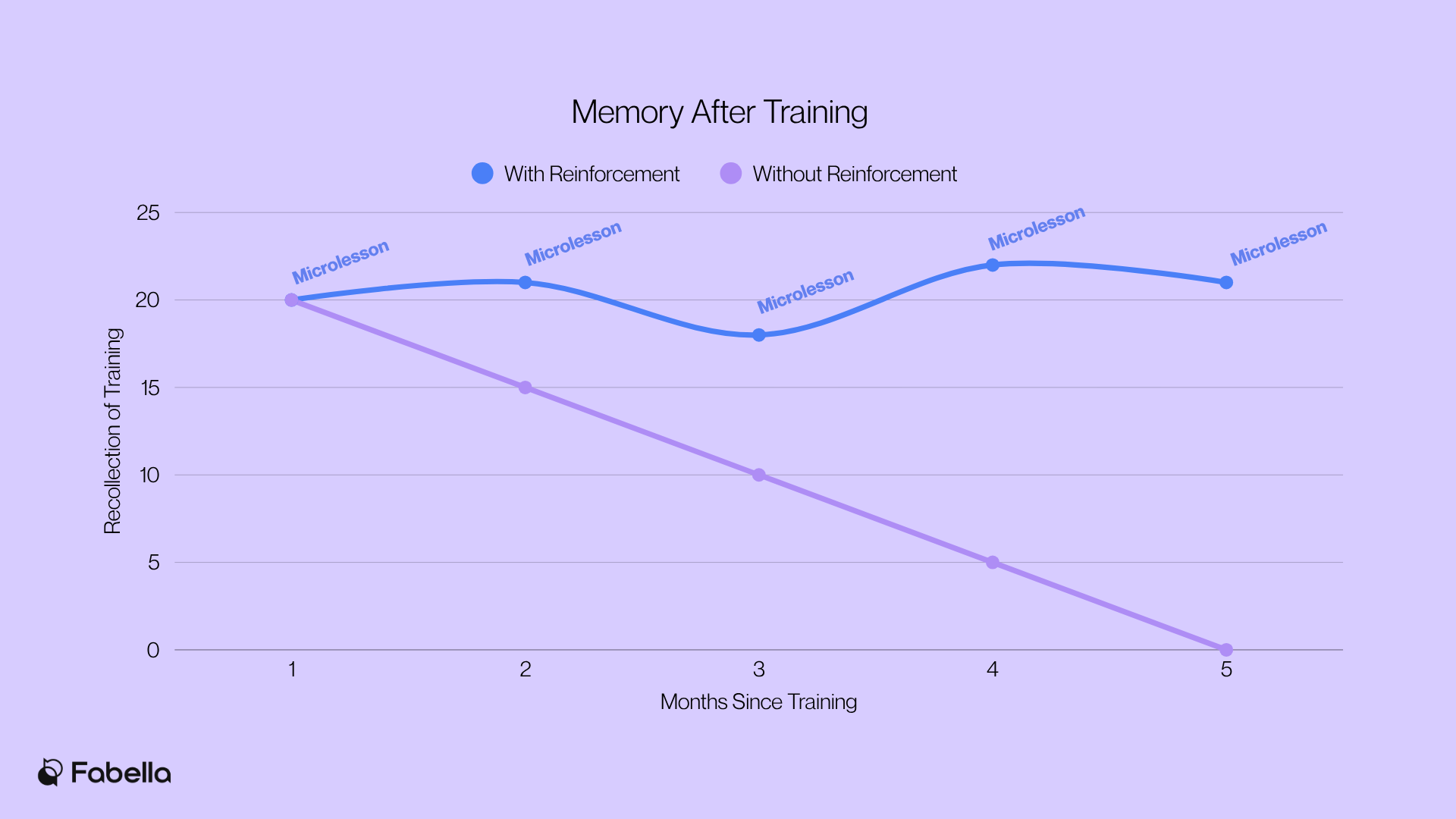
Without reinforcement, people naturally forget what they've learned over time. That's not a failure of learners. It's simply how memory works.

The question isn't whether learners will forget.

It's what we're doing to help them remember.

What the Research Says

The evidence for spaced learning is among the strongest in learning science.

A 2024 meta-analysis examining spaced retrieval practice across STEM disciplines found that spacing and retrieval worked particularly well together. Learners didn't just remember more - they retained knowledge for longer and transferred it more effectively to new situations.

The same pattern appears in digital learning environments. A 2024 meta-analysis published in the Journal of Medical Internet Research found that spaced digital education improved learning outcomes across a variety of online contexts. There's an important nuance here, though.

Spacing isn't magic.

Simply sending reminder emails or reposting old content isn't enough. The most effective reinforcement includes opportunities for retrieval, feedback, reflection, and application. Timing matters. Feedback matters. The design of the activity matters.

The goal isn't repetition.

The goal is strengthening memory through repeated use.

Bringing the Principles Together

It's tempting to think about these principles independently.

Performance outcomes. Cognitive load. Retrieval practice. Reinforcement.

But high-performing eLearning doesn't rely on any one of them in isolation.

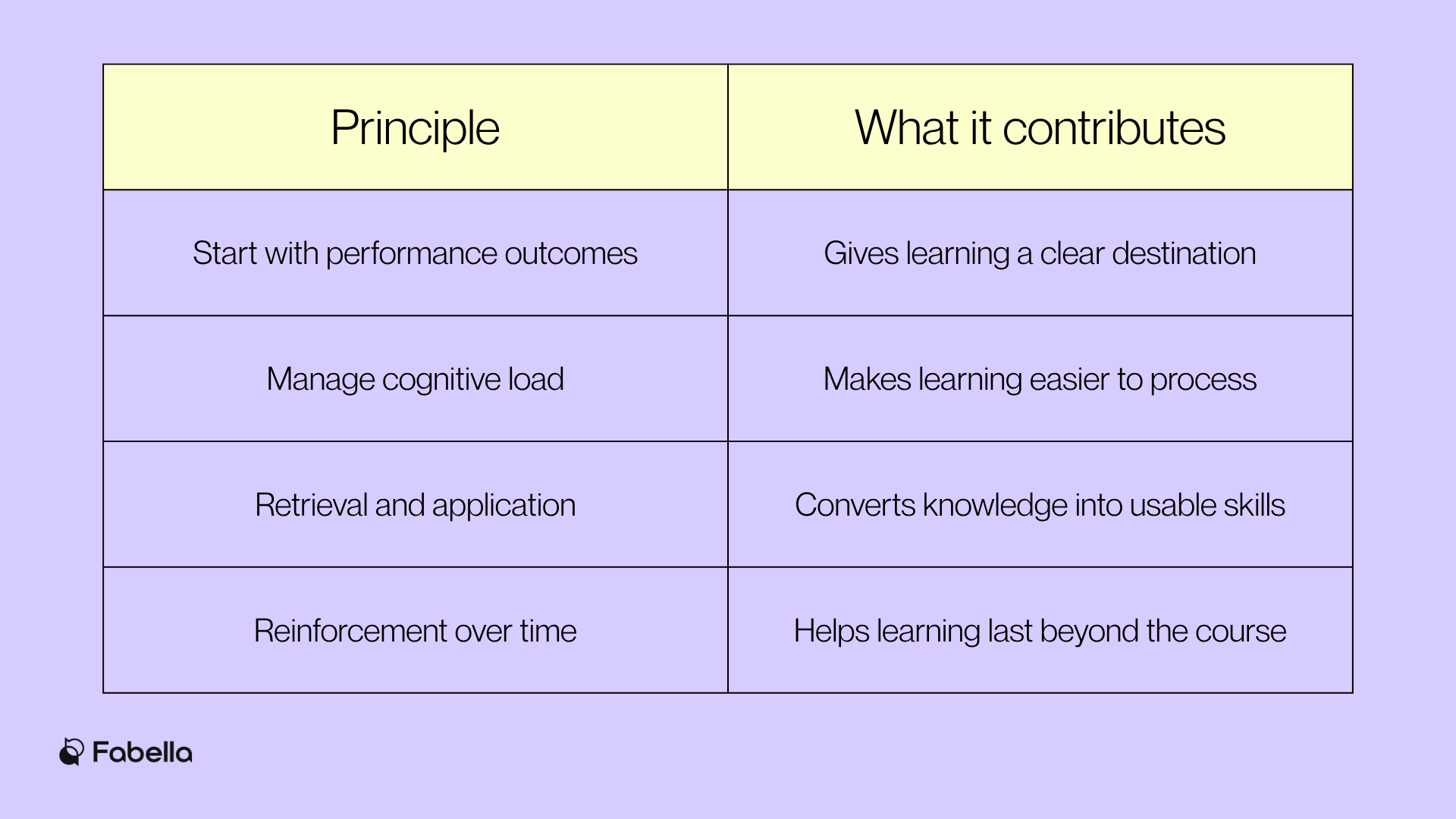
The best learning experiences combine all four into a single learning system.

Notice how each principle builds on the previous one. First, you identify the performance you're trying to improve. Then you remove unnecessary barriers to learning. Next, you create opportunities for learners to think, decide, and apply. Finally, you reinforce learning over time so it doesn't disappear once the course ends. 

Organizations that apply these principles are more likely to see:

  • Higher learner engagement
  • Better knowledge retention
  • Faster skill acquisition
  • Greater confidence on the job
  • Improved business performance
  • Stronger return on learning investment

And that's the real point.

High-performing eLearning isn't defined by how polished it looks or how many people finish it.

It's defined by whether learners can perform differently when it matters.

Support
and
Further
Assistance
For any additional questions or assistance, reach out to Fabella’s customer support team at support@fabella.io. We are readily available to address any queries and provide any guidance you may need.
Gamification
Resources
Development
Insights